
Details
| Full name | Tradescantia (Continental Group) ‘Jara’. |
| Name status | Accepted, the valid name for a unique cultivar. Registered in 2024, the name will be established once published in hardcopy (Brickell et al., 2016, Art. 27.1). |
| Origins | Sport mutation from Tradescantia ‘Albovittata’ first discovered in 2021, which may have arisen independently multiple times. Named after the registrant’s grandmother Jaroslava who owned the original parent plant. In Czech Jaroslava means spring celebration, and jaro means spring. The name is pronounced “yara” in English. Selected, named, registered, and introduced by Eva Šusteková in Prague, Czech Republic. |
| Classification | Like the parent cultivar, it is now placed in the Continental Group. These cultivars are often mislabelled as T. albiflora or T. fluminensis, but do not fully match that species are appear to be hybrids in the Austrotradescantia subgenus. |
| Legal protection | None. |
| Availability | Locally available in Europe and the UK. |
Description
Described with reference to the RHS Colour Chart (6th Edition; 2019 reprint).
| Cultivar group | Tradescantia Continental Group. |
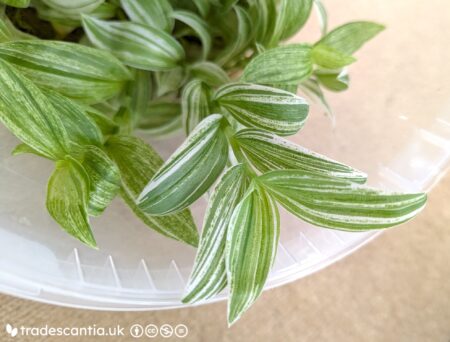
| Growth habit | Long stems which grow strongly downwards, creeping or trailing out of any container. |
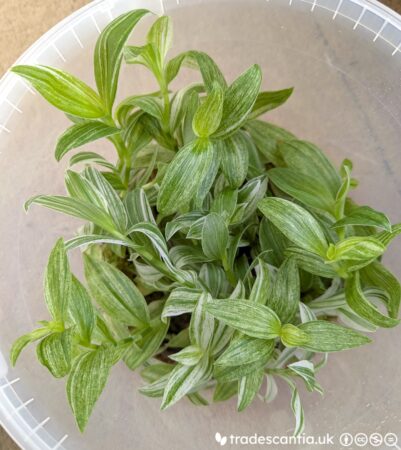
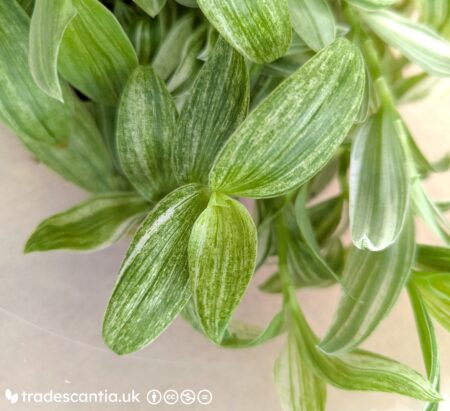
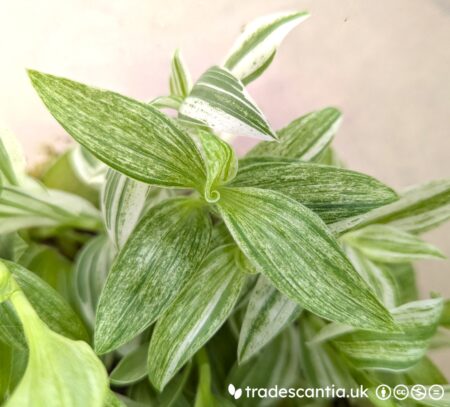
| Foliage | Stems are 2-7mm wide with internodes 1-4cm long, strong yellow green (144A) to moderate olive brown (N199A), smooth except for a line of tiny hairs running along the length. Leaves are narrow pointed ovals, 4-12cm long and 1.5-5cm wide, smooth except for a few long hairs at the top of the sheath, with random mottled variegation. On the upper surface, the pale areas are yellowish white (196D) to greenish white (192D), and the dark areas are greyish olive green (NN137A to NN137C). On the undersides, the pale areas are yellowish white (196D) to very pale green (192C), and the dark areas are greyish yellow green (194A) to pale green (N138C). Leaf sheaths are moderate yellow green (143D) to greyish yellow green (191B). |
| Flowers | Not observed yet, most likely identical to ‘Albovittata’: 12-15mm across and pure white with yellow anthers. |
| Comparisons | Compared to ‘Albovittata’, the variegation has no sharp edges but instead a blurred pattern. Compared to other Continental Group cultivars, the growth habit is more trailing with longer stems. |
References
Brickell, C. D., Alexander, C., Cubey, J. J., David, J. C., Hoffman, M. H. A., Leslie, A. C., Malécot, V., Jin, X. (2016). International Code of Nomenclature for Cultivated Plants. PDF link.